After an unsuccessful 2011 growing season, I've spent the past month trying to hunt down an open spot in one of the community gardens in Northern Virginia. Unfortunately, there aren't many of them, and of the ones I've found so far, have multi-year waiting lists.
Given the partial sunlight issue I still seem to have (I have traded in afternoon sun for morning sun), the gardening attempts will be focused only on herbs this year. Maybe some small flowers. We'll see.
If anyone knows of an open community garden spot in NoVa, let me know!
Thursday, January 26, 2012

Wednesday, June 1, 2011
Lazy gardener
So I have been guilty lately of being a lazy gardner. Or maybe thoroughly disappointed and therefore questioning the potential for better results.
I have been babying all my plants, checking on them daily. I noticed that all my plants stop growing taller once they are outside, even when given adequate water. The veggie plants seem to go to flower much too quickly in their lifecycle - they should be growing much taller before they bud. Once they go to flower, they stop growing taller and focus on growing fruit. I'm not sure how to force upward/outward growth.
The second round of pea plants have flowered and are sprouting peas, but the results aren't much better than the first round of plants. They are barely fruiting enough for a single serving of pea pods.
The previously questionable cucumber has also gone to flower. The plant grew some additional leaves once planted outside, although the size is still underwhelming. I'm not sure what size cucumbers this plant can handle - it's barely a cucumber wide itself!
The pepper seedlings which are outside haven't budged an inch upward, outward, sideways or downwards. Nothing. They look exactly as they did three weeks ago when I planted them. No new leaf growth. Puzzling.
I'll probably plant the final remaining tomato and pepper seedlings (basically until the soil runs out) and call it a season. I'm not going to go crazy building any fancy self-watering systems if sunlight is the issue (which is the only conclusion I can come to). The plants haven't shown any sign of underwatering, overwatering, disease, pests. They just are... midget and don't want to grow!
Urban gardening isn't easy when you're missing full-day direct sunlight. Afternoon sun just doesn't seem enough. Despite what all the books, website and other material state about the ease of growing container plants, they all assume your tiny deck is getting the right angle of sunlight for enough hours a day. At least for vegetables. Unfortunately, that can't happen on the deck I have.
Just to prove I'm not a total brown thumb, my pothos, which I divided and took cutlings from last year, is ready for another round of cuttings.
I have been babying all my plants, checking on them daily. I noticed that all my plants stop growing taller once they are outside, even when given adequate water. The veggie plants seem to go to flower much too quickly in their lifecycle - they should be growing much taller before they bud. Once they go to flower, they stop growing taller and focus on growing fruit. I'm not sure how to force upward/outward growth.
The second round of pea plants have flowered and are sprouting peas, but the results aren't much better than the first round of plants. They are barely fruiting enough for a single serving of pea pods.
The previously questionable cucumber has also gone to flower. The plant grew some additional leaves once planted outside, although the size is still underwhelming. I'm not sure what size cucumbers this plant can handle - it's barely a cucumber wide itself!
The pepper seedlings which are outside haven't budged an inch upward, outward, sideways or downwards. Nothing. They look exactly as they did three weeks ago when I planted them. No new leaf growth. Puzzling.
I'll probably plant the final remaining tomato and pepper seedlings (basically until the soil runs out) and call it a season. I'm not going to go crazy building any fancy self-watering systems if sunlight is the issue (which is the only conclusion I can come to). The plants haven't shown any sign of underwatering, overwatering, disease, pests. They just are... midget and don't want to grow!
Urban gardening isn't easy when you're missing full-day direct sunlight. Afternoon sun just doesn't seem enough. Despite what all the books, website and other material state about the ease of growing container plants, they all assume your tiny deck is getting the right angle of sunlight for enough hours a day. At least for vegetables. Unfortunately, that can't happen on the deck I have.
Just to prove I'm not a total brown thumb, my pothos, which I divided and took cutlings from last year, is ready for another round of cuttings.
Friday, May 13, 2011
Planting Calculator
Johnny's Select Seeds in Maine has added me to their mailing list and today's email came with a little link at the bottom. This web site will allow you to enter the last frost date in your area and the web site will calculate when you should plant seeds outside, whether they need to be started indoors, and how many weeks ahead of time.
Seed Planting Calculator
Master Gardners estimated the frost date as May15th, but in reality, we've had 50-70 degree weather since the last week of April.
My second set of peas are growing much stronger than my first set. I have two one-pea-pods hanging off the first set still struggling to stand up. This weekend, I'm replacing them with the last of the newer pea plants sitting in my windowsill. May the sacrifice of the few be the fortune of my taste buds come summer!
Seed Planting Calculator
Master Gardners estimated the frost date as May15th, but in reality, we've had 50-70 degree weather since the last week of April.
My second set of peas are growing much stronger than my first set. I have two one-pea-pods hanging off the first set still struggling to stand up. This weekend, I'm replacing them with the last of the newer pea plants sitting in my windowsill. May the sacrifice of the few be the fortune of my taste buds come summer!
Saturday, April 30, 2011
Moving outdoors take 2
Was it really seven days ago I planted those new pea plants in plastic cells and plopped them in my window? A week later I'm planting four outside because they've outgrown their cells! It's amazing how well the second batch has grown - makes the batch currently outside look lame. I'll give the older peas another two weeks to get the leg on, otherwise, they are getting replaced.
I'm wondering if I started some plants inside too early and should have waited -- although I was following the general directions of the MG. It may be that container gardening needs to run on a different schedule than terra firma gardening.
The cucumber plants seem to be recovering from their earlier scare - the white spots dried up and now new leaves are growing. I've left the bottle cloches off all week and that seems to be helping immensely. A check of the weather and night time temperatures min out at 49 this week - I'm beyond the frost scare. I'll also give these two more weeks to recover or be replaced.
I took four carnival pepper plants and four italian style pepper plants and put them outside in my second window box. A couple of the plants that had been standing strong now are leaning to the side. I'm hoping a few days outside in gorgeous weather will change things.
Tomorrow I will make a trip to the home depot or walmart and decide how to finish the planting. I have a few lettuce sprouts that look extremely healthy and need to go outside ASAP along with at least four more pea plants. I also need to get a deeper vessel, possibly a bucket, for the tomato plants. I'm leaning towards attempting the self-watering container directions with smaller bins. I need to find a happy medium - big enough for the plant's roots but will still fit on my patio without being too heavy for me to move around.
I'm wondering if I started some plants inside too early and should have waited -- although I was following the general directions of the MG. It may be that container gardening needs to run on a different schedule than terra firma gardening.
The cucumber plants seem to be recovering from their earlier scare - the white spots dried up and now new leaves are growing. I've left the bottle cloches off all week and that seems to be helping immensely. A check of the weather and night time temperatures min out at 49 this week - I'm beyond the frost scare. I'll also give these two more weeks to recover or be replaced.
I took four carnival pepper plants and four italian style pepper plants and put them outside in my second window box. A couple of the plants that had been standing strong now are leaning to the side. I'm hoping a few days outside in gorgeous weather will change things.
Tomorrow I will make a trip to the home depot or walmart and decide how to finish the planting. I have a few lettuce sprouts that look extremely healthy and need to go outside ASAP along with at least four more pea plants. I also need to get a deeper vessel, possibly a bucket, for the tomato plants. I'm leaning towards attempting the self-watering container directions with smaller bins. I need to find a happy medium - big enough for the plant's roots but will still fit on my patio without being too heavy for me to move around.
Saturday, April 23, 2011
Starting fresh
Some good news. After an emergency drink of water, about half of the sweet italian style peppers bounced back from yesterday. I'm going to have to watch those seed blocks like a hawk and make sure they have plenty of water.
I planted another 4 sets of 9 plastic cells with remaining seeds. I did 18 of peas, 9 of lettuce and 9 with orange blossom tomato. My hope is that the weather will even out at night by the time these sprout and won't need as much time indoors to avoid frosty nights.
I also planted two small plastic pots with flower seeds. I filled one with shasta daisies and the other with lavander. It was only after I opened the packet that I saw the fine print that lavender doesn't flower until the second year. No loss. It doesn't cost me any additional room and if they don't make it I can reuse the pot for my cut pothos.
I also cleaned the seed block and put it away for the season. After playing with it, I do think it could be a very good tool for growing plants, but:
1. you need a consistent method of providing water or some kind of sponge system
2. you need more room than a typical 9 plastic cell shell
3. you need to watch them like a hawk if you have a dry area. really, it's all about #1!
If you can better control temperature and moisture levels, I think the soil blocker is a good idea. If you are renting a small apartment and using your kitchen counter as the space for growing seedlings, I'd skip the soil blocker and stick with the plastic cells.
I planted another 4 sets of 9 plastic cells with remaining seeds. I did 18 of peas, 9 of lettuce and 9 with orange blossom tomato. My hope is that the weather will even out at night by the time these sprout and won't need as much time indoors to avoid frosty nights.
I also planted two small plastic pots with flower seeds. I filled one with shasta daisies and the other with lavander. It was only after I opened the packet that I saw the fine print that lavender doesn't flower until the second year. No loss. It doesn't cost me any additional room and if they don't make it I can reuse the pot for my cut pothos.
I also cleaned the seed block and put it away for the season. After playing with it, I do think it could be a very good tool for growing plants, but:
1. you need a consistent method of providing water or some kind of sponge system
2. you need more room than a typical 9 plastic cell shell
3. you need to watch them like a hawk if you have a dry area. really, it's all about #1!
If you can better control temperature and moisture levels, I think the soil blocker is a good idea. If you are renting a small apartment and using your kitchen counter as the space for growing seedlings, I'd skip the soil blocker and stick with the plastic cells.
Friday, April 22, 2011
Wilting away
So apparently this is what happens when you have soil block seedlings sitting in a hot, dry apartment and forget to water them for the first time before you run out the door to work.


 My peapods outside seem to have had an identity crisis. While some of the plants are growing up the bamboo stake two of them decided to flower and bud peapods much too early. The plants are so small they can barely hold the weight of a three pea pod.
 I guess the good news is that I still have plenty of seed soil (from dead plants) and some seeds that I can try again with most of the species. I don't have much tomato seeds left though - the "mini" packets from Johnny's didn't leave much room for error. The rest I am going to give another try, including the lettuce seedlings that failed last month.

Yup. I tried some recovery water when I got home, but I suspect all but two are goners. They were the "italian sweet peppers" from home depot and had been doing great. Until today.

There really isn't much I can do to control the heat or humidity in my apartment. I live above the main entry way so the temperature in the lobby determines the temperature in my apartment. Attempts to cool down the place short of leaving the windows open all day are unsuccessful. As for humidity, I have a bedroom humidifier and a small one in my office. Neither is big enough that it would be able to treat my whole apartment.

A check on my other seedlings. The orange blossom tomatos are doing lousy independent of whether they are in the plastic cells or seed blocks. The valley girl reds are doing marginally better, but not fantastic. The eggplants are finally getting tall enough that they are at a do-or-die stage this weekend. To the left are the other peppers, the "carnival" peppers, or full size non-green bell peppers. Those seem to be doing better in their tupperware containers. I think it retains moisture better than the regular plastic trays.
 My peapods outside seem to have had an identity crisis. While some of the plants are growing up the bamboo stake two of them decided to flower and bud peapods much too early. The plants are so small they can barely hold the weight of a three pea pod.
My cucumber plants seem to have caught some sort of a disease or are dealing with sun-stroke. While the soda bottles work wonders at keeping plants alive during the cold nights, remembering to take the bottles off during warm days (especially last weekend when I wasn't home) seems to have doomed half of my cucumber plants. I'm assuming they got steamed too much over last weekend and developed a white blanched look; I'm going to guess that recovery is slim at this point.
 I guess the good news is that I still have plenty of seed soil (from dead plants) and some seeds that I can try again with most of the species. I don't have much tomato seeds left though - the "mini" packets from Johnny's didn't leave much room for error. The rest I am going to give another try, including the lettuce seedlings that failed last month.
Saturday, April 9, 2011
Day 1 Outside
I checked on the newly transplanted peas and cucumbers after a very rainy Friday. Turns out Friday night was windy as well. The items I left out on the balcony had relocated to the far corner and one of the soda bottles had fallen over. I cleaned up and reset the soda bottles and pushed each into the soil gently.
I added some water by spraying down the sides of each bottle from the opening. I am going to need to add watering can to my shopping list. So far I've only seen huge outdoor cans with giant openings. I need a smaller watering can with a fine long spout, but this $62 unit is too steep. Leave it to Target to put design over function in their cheaper version - the handle is in the way! I probably would do better in the florist section of a grocery store.
Speaking of watering, last night I was reading a book from the library called "Incredible Vegetables from Self-Watering Containers". The book was written by a Vermont hobbyist who struggled with earth gardens due to the fertility of soil. He had spent a summer doing regular container gardening and was disappointed with the results. The next summer he tried several self-watering containers and was hooked.
First results from online searches for self-watering containers bring you to very expensive specialist gardening companies. While I appreciate their ingenuity and entrepreneurial spirit, I find $50 for a small windowbox sized container a bit expensive. The leader seems to be Earthbox with a combination self-watering container and fertilizer unit. Prices start at $59 and go higher.
After a little more research, I ended up right back with the Virginia Master Gardeners association. I can't tell if these guys are just really well published on the web or if they are one of the most active MG associations. This time it was the Southern VA group with an online tutorial on how to build your own self-watering container. The $7 estimate is a little fictitious - if you don't already have weed cloth sitting around you'll have to buy a roll, which will be more than the $1 estimate. But overall, the expense ends up being close to what I am paying for a single windowbox sized container that isn't self-watering. I am going to need one or two more containers when the tomato and peppers are ready. These look like a good solution.
I added some water by spraying down the sides of each bottle from the opening. I am going to need to add watering can to my shopping list. So far I've only seen huge outdoor cans with giant openings. I need a smaller watering can with a fine long spout, but this $62 unit is too steep. Leave it to Target to put design over function in their cheaper version - the handle is in the way! I probably would do better in the florist section of a grocery store.
Speaking of watering, last night I was reading a book from the library called "Incredible Vegetables from Self-Watering Containers". The book was written by a Vermont hobbyist who struggled with earth gardens due to the fertility of soil. He had spent a summer doing regular container gardening and was disappointed with the results. The next summer he tried several self-watering containers and was hooked.
First results from online searches for self-watering containers bring you to very expensive specialist gardening companies. While I appreciate their ingenuity and entrepreneurial spirit, I find $50 for a small windowbox sized container a bit expensive. The leader seems to be Earthbox with a combination self-watering container and fertilizer unit. Prices start at $59 and go higher.
After a little more research, I ended up right back with the Virginia Master Gardeners association. I can't tell if these guys are just really well published on the web or if they are one of the most active MG associations. This time it was the Southern VA group with an online tutorial on how to build your own self-watering container. The $7 estimate is a little fictitious - if you don't already have weed cloth sitting around you'll have to buy a roll, which will be more than the $1 estimate. But overall, the expense ends up being close to what I am paying for a single windowbox sized container that isn't self-watering. I am going to need one or two more containers when the tomato and peppers are ready. These look like a good solution.
Friday, April 8, 2011
First round of planting
My second set of plants have sprouted and are doing well. My pepper plants have continued to grow slowly. The tomato plants have been thriving and growing solid. Random seedlings from each variety have wimped out and bent over. Unfortunately, the lettuce sprouts are officially dead. RIP. I may try again later.
 Although the MG training session suggested not moving plants outside until May, I am finding that some plants are in desperate need of being staked. I haven't figured out a good way to get them climbing that can be continued when the seedlings are transplanted outside. My pea plants were doubled over in their plastic cells and the cucumber sprouts in both soil blocks and plastic cells are beginning to droop right as they sprout their first true leaves.
While I'm risking death, if I don't plant them now, all the pea and cucumber seedlings are guaranteed to die. I wonder how people are able to keep such plants indoors for 6-8 weeks. I suspect my kitchen, even with grow lights, just isn't bright enough.
 I brought my goodies from my trip to Home Depot to the balcony and surveyed the results. I have everything I need for now, at least to get some planting started.

I used some left over gravel to line the bottom of the planters and started shoveling the Miracle Grow container soil. Having worked briefly with this soil, I would not recommend it. It has too many sticks, rocks and other tidbits. I understand I bought "organic" potting soil, but organic sticks don't help little vegetable plants grow.
 I popped the pea plants out of their plastic cells and arranged 5 of them in a circle around a standing bamboo stake. I patted the soil down around them and then went back inside. Who needs $4 garden ties when you have neon yellow yarn left over from a failed crochet project? I tied a knot around the plant stem and a knot around the bamboo stake. I then dropped a soda bottle cloch down the stake and around the pea plants.
Mental Note: Scissors and box cutters are not sharp enough to cut through even thin bamboo.

I then took the four best looking cucumber plants that had been growing in the soil blocks. 1 plant had failed to sprout and 1 had already fallen over. I dropped the plants into the dirt and covered with the second soda bottle. The third seedling group was from the plastic cell grown cucumbers. 1 plant snapped when I tried to get it out of the plastic cell. I was left with 5 good plants, 4 of which I planted and covered. I need to plant 3 more pea plants, but I ran out of soda bottles. With the weather being rather dismal and gray (in the 50's and cloudy all weekend), placing them outside with no cover is too risky.
Then again, Monday is supposed to hit 86 degrees. And I thought New England had wacky weather patterns!
Soil Blocks vs Plastic Cells
Seedlings:
1. Plastic cell plants sprouted first in all cases, with the head start being anywhere between 2-5 days. Slow sprouting plants had a larger difference and the time to sprout was more noticeable.
2. Soil blocked plants are less likely to be knocked down by watering and seem to generally stand on their own better. It's also easier to give them extra room if they get leggy.
3. Soil blocked plants require ALOT more water than plastic cell seedlings. I can't tell if it's my apartment or the blocks, but having so many sides exposed to air dries out the blocks much faster than cells. I've found myself watering daily.
Planting:
4. Planting soil blocked seedlings is a snap: dig hole, drop in the block, cover. Removing plastic cell seedlings can be risky: I lost one pea and one cucumber plant today.
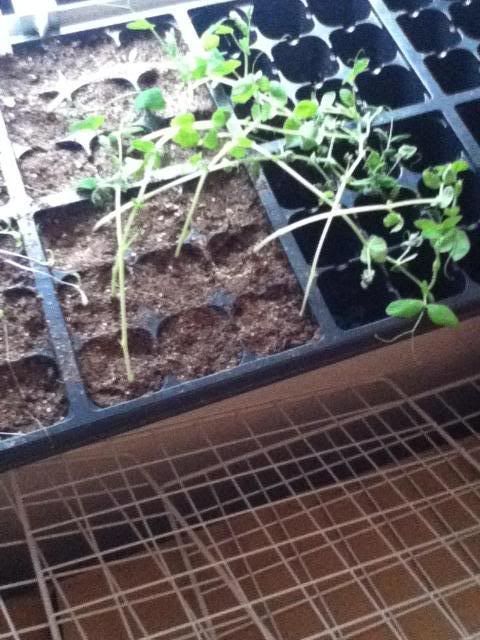 Although the MG training session suggested not moving plants outside until May, I am finding that some plants are in desperate need of being staked. I haven't figured out a good way to get them climbing that can be continued when the seedlings are transplanted outside. My pea plants were doubled over in their plastic cells and the cucumber sprouts in both soil blocks and plastic cells are beginning to droop right as they sprout their first true leaves.
 While I'm risking death, if I don't plant them now, all the pea and cucumber seedlings are guaranteed to die. I wonder how people are able to keep such plants indoors for 6-8 weeks. I suspect my kitchen, even with grow lights, just isn't bright enough.
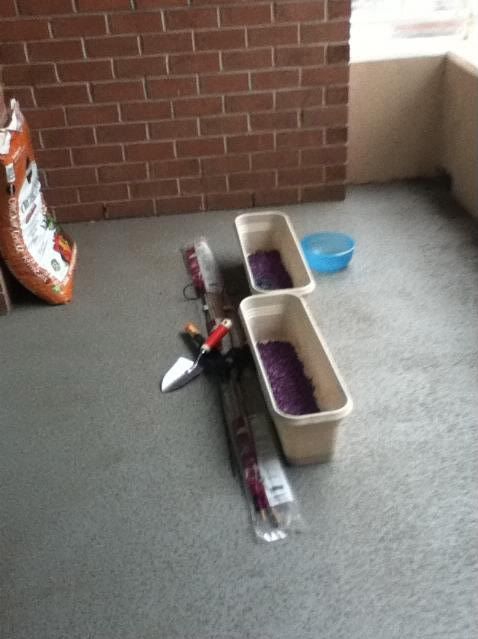 I brought my goodies from my trip to Home Depot to the balcony and surveyed the results. I have everything I need for now, at least to get some planting started.
I used some left over gravel to line the bottom of the planters and started shoveling the Miracle Grow container soil. Having worked briefly with this soil, I would not recommend it. It has too many sticks, rocks and other tidbits. I understand I bought "organic" potting soil, but organic sticks don't help little vegetable plants grow.
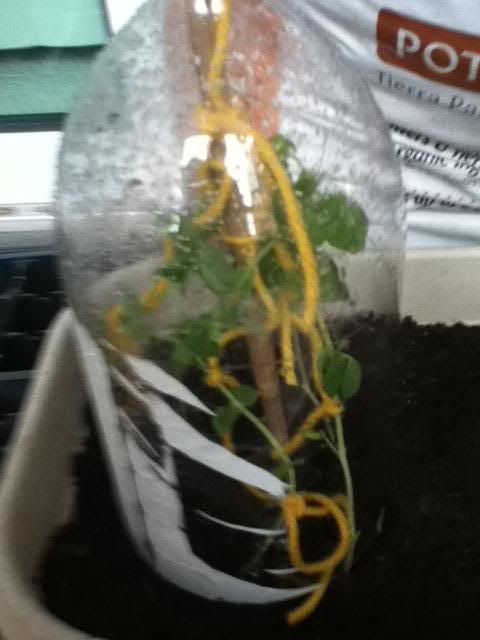 I popped the pea plants out of their plastic cells and arranged 5 of them in a circle around a standing bamboo stake. I patted the soil down around them and then went back inside. Who needs $4 garden ties when you have neon yellow yarn left over from a failed crochet project? I tied a knot around the plant stem and a knot around the bamboo stake. I then dropped a soda bottle cloch down the stake and around the pea plants.
Mental Note: Scissors and box cutters are not sharp enough to cut through even thin bamboo.
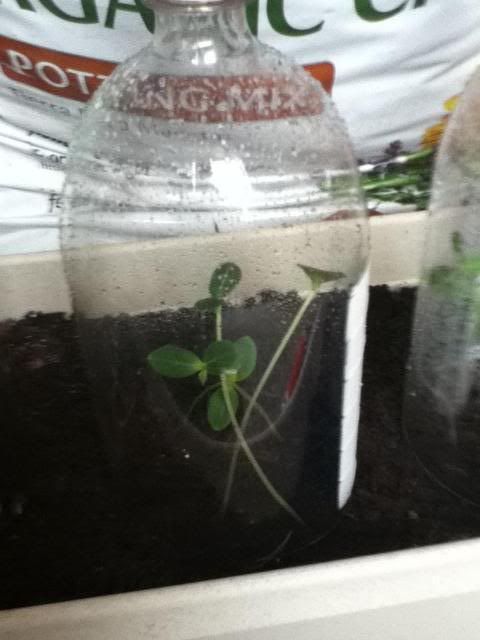
I then took the four best looking cucumber plants that had been growing in the soil blocks. 1 plant had failed to sprout and 1 had already fallen over. I dropped the plants into the dirt and covered with the second soda bottle. The third seedling group was from the plastic cell grown cucumbers. 1 plant snapped when I tried to get it out of the plastic cell. I was left with 5 good plants, 4 of which I planted and covered. I need to plant 3 more pea plants, but I ran out of soda bottles. With the weather being rather dismal and gray (in the 50's and cloudy all weekend), placing them outside with no cover is too risky.
Then again, Monday is supposed to hit 86 degrees. And I thought New England had wacky weather patterns!
Soil Blocks vs Plastic Cells
Seedlings:
1. Plastic cell plants sprouted first in all cases, with the head start being anywhere between 2-5 days. Slow sprouting plants had a larger difference and the time to sprout was more noticeable.
2. Soil blocked plants are less likely to be knocked down by watering and seem to generally stand on their own better. It's also easier to give them extra room if they get leggy.
3. Soil blocked plants require ALOT more water than plastic cell seedlings. I can't tell if it's my apartment or the blocks, but having so many sides exposed to air dries out the blocks much faster than cells. I've found myself watering daily.
Planting:
4. Planting soil blocked seedlings is a snap: dig hole, drop in the block, cover. Removing plastic cell seedlings can be risky: I lost one pea and one cucumber plant today.
Saturday, March 26, 2011
Playing with dirt
Gardening might be the only excuse adults have to play in the dirt and not feel guilty.
Today I managed to get a second set of seedlings planted indoors. I am beginning my experiment on testing soil blocks versus plastic cell raised seedlings. I planted four vegetables today: orange blossom tomatoes, valley girl tomatoes, fairy tale eggplants, and straight eight cucumbers. I didn't come up with the names, the growers did.

 The soil blocks can be tricky. I've learned that the soil needs to more wet than dry, but not soaking wet. While a circular bucket isn't the best vessel for soil blocking, it's all I have to contain the mess. Pile the soil into the center of the bucket and pack down. Press the soil blocker into the dirt until you feel the bottom of the bucket. Twist the entire soil blocker and press on the handle gently before lifting. Now here's my new trick. Pack the dirt in from the bottom of the cells. Squish the wet soil into each block and pack in more dirt and smooth to the bottom of the blocker. In another bucket or the other side of the sink, place the soil blocker on the surface and press the handle down all the way while slowly raising the soil blocker. Blocks should be formed, level with a noticeable dimple in the middle. If they are too short or falling apart, throw them back into the bucket. Allow blocks to sit for a few minutes before attempting to move. Any that fall apart on touch, back into the bucket. Place seeds into each dimple and cover with a very small amount of wet soil.

Today I managed to get a second set of seedlings planted indoors. I am beginning my experiment on testing soil blocks versus plastic cell raised seedlings. I planted four vegetables today: orange blossom tomatoes, valley girl tomatoes, fairy tale eggplants, and straight eight cucumbers. I didn't come up with the names, the growers did.
I planted each variety in a 9 plastic cell block and 6 soil blocks. The numbers aren't even because the soil blocks are bigger and I'm running out of counter space. I managed to get these all planted in about half the time it took me to do the first batch - learning is taking place!

I continued to use the Jiffy organic seed starter mix. I put some small pebbles in the bottom of each plastic cell to enhance drainage and filled about 3/4 with wet seed soil. I used the blunt end of a cheap pen to press a dimple into the soil. I have discovered that the plastic $4 seed dispenser from Johnny's Select Seeds wasn't a good investment - this is pictured to the left with pepper seeds from the first round. Instead, a $1 pair of tweezers do a better job of handling small seeds and delivering them to the holes. I then covered each cell with a small layer of wet soil, making sure to fill in the seed holes.
 The soil blocks can be tricky. I've learned that the soil needs to more wet than dry, but not soaking wet. While a circular bucket isn't the best vessel for soil blocking, it's all I have to contain the mess. Pile the soil into the center of the bucket and pack down. Press the soil blocker into the dirt until you feel the bottom of the bucket. Twist the entire soil blocker and press on the handle gently before lifting. Now here's my new trick. Pack the dirt in from the bottom of the cells. Squish the wet soil into each block and pack in more dirt and smooth to the bottom of the blocker. In another bucket or the other side of the sink, place the soil blocker on the surface and press the handle down all the way while slowly raising the soil blocker. Blocks should be formed, level with a noticeable dimple in the middle. If they are too short or falling apart, throw them back into the bucket. Allow blocks to sit for a few minutes before attempting to move. Any that fall apart on touch, back into the bucket. Place seeds into each dimple and cover with a very small amount of wet soil.
The trick seems to be getting the right soil to water ratio. Too dry and the soil crumbles before you can get the blocks out. Too wet and the blocks crumble when you move them to their permanent location. It's about balance and takes some practice - add a little more water or soil to get the consistency right.
I also "installed" my second grow light from WalMart. Copious use of masking tape is keeping both lights hanging to avoid drilling holes in my apartment. The first light has only fallen once; a second application of masking tape has kept it hanging for the last two weeks. I have enough counter space for either one set of 6 blocks or two more 9-cell plantings. Since my lettuce seeds failed miserably, I'm debating trying again or just waiting to sow outside.
I also mixed my first batch of plant food using a recipe from the Master Gardener lecture I attended. Essentially it's mixing a batch of liquid plant food at half strength and adding a half teaspoon of white vinegar to help keep disease and mold away. For my liquid plant food, this ended up being 8 cups of filtered water, half teaspoon of white vinegar and 7 drops of food. I don't know if this was the best brand to pick, but the Master Gardener suggested not getting Miracle Grow - he said while it's popular, it's not the best on the market. Schultz was the only alternative available at Lowe's. This plant food is for the existing seedlings and not for the ones I just made today. The MG said white vinegar could kill a baby seed or the plant food could burn the stem as soon as it sprouts.
Subscribe to:
Comments (Atom)