Was it really seven days ago I planted those new pea plants in plastic cells and plopped them in my window? A week later I'm planting four outside because they've outgrown their cells! It's amazing how well the second batch has grown - makes the batch currently outside look lame. I'll give the older peas another two weeks to get the leg on, otherwise, they are getting replaced.
I'm wondering if I started some plants inside too early and should have waited -- although I was following the general directions of the MG. It may be that container gardening needs to run on a different schedule than terra firma gardening.
The cucumber plants seem to be recovering from their earlier scare - the white spots dried up and now new leaves are growing. I've left the bottle cloches off all week and that seems to be helping immensely. A check of the weather and night time temperatures min out at 49 this week - I'm beyond the frost scare. I'll also give these two more weeks to recover or be replaced.
I took four carnival pepper plants and four italian style pepper plants and put them outside in my second window box. A couple of the plants that had been standing strong now are leaning to the side. I'm hoping a few days outside in gorgeous weather will change things.
Tomorrow I will make a trip to the home depot or walmart and decide how to finish the planting. I have a few lettuce sprouts that look extremely healthy and need to go outside ASAP along with at least four more pea plants. I also need to get a deeper vessel, possibly a bucket, for the tomato plants. I'm leaning towards attempting the self-watering container directions with smaller bins. I need to find a happy medium - big enough for the plant's roots but will still fit on my patio without being too heavy for me to move around.
Saturday, April 30, 2011

Saturday, April 23, 2011
Starting fresh
Some good news. After an emergency drink of water, about half of the sweet italian style peppers bounced back from yesterday. I'm going to have to watch those seed blocks like a hawk and make sure they have plenty of water.
I planted another 4 sets of 9 plastic cells with remaining seeds. I did 18 of peas, 9 of lettuce and 9 with orange blossom tomato. My hope is that the weather will even out at night by the time these sprout and won't need as much time indoors to avoid frosty nights.
I also planted two small plastic pots with flower seeds. I filled one with shasta daisies and the other with lavander. It was only after I opened the packet that I saw the fine print that lavender doesn't flower until the second year. No loss. It doesn't cost me any additional room and if they don't make it I can reuse the pot for my cut pothos.
I also cleaned the seed block and put it away for the season. After playing with it, I do think it could be a very good tool for growing plants, but:
1. you need a consistent method of providing water or some kind of sponge system
2. you need more room than a typical 9 plastic cell shell
3. you need to watch them like a hawk if you have a dry area. really, it's all about #1!
If you can better control temperature and moisture levels, I think the soil blocker is a good idea. If you are renting a small apartment and using your kitchen counter as the space for growing seedlings, I'd skip the soil blocker and stick with the plastic cells.
I planted another 4 sets of 9 plastic cells with remaining seeds. I did 18 of peas, 9 of lettuce and 9 with orange blossom tomato. My hope is that the weather will even out at night by the time these sprout and won't need as much time indoors to avoid frosty nights.
I also planted two small plastic pots with flower seeds. I filled one with shasta daisies and the other with lavander. It was only after I opened the packet that I saw the fine print that lavender doesn't flower until the second year. No loss. It doesn't cost me any additional room and if they don't make it I can reuse the pot for my cut pothos.
I also cleaned the seed block and put it away for the season. After playing with it, I do think it could be a very good tool for growing plants, but:
1. you need a consistent method of providing water or some kind of sponge system
2. you need more room than a typical 9 plastic cell shell
3. you need to watch them like a hawk if you have a dry area. really, it's all about #1!
If you can better control temperature and moisture levels, I think the soil blocker is a good idea. If you are renting a small apartment and using your kitchen counter as the space for growing seedlings, I'd skip the soil blocker and stick with the plastic cells.
Friday, April 22, 2011
Wilting away
So apparently this is what happens when you have soil block seedlings sitting in a hot, dry apartment and forget to water them for the first time before you run out the door to work.


 My peapods outside seem to have had an identity crisis. While some of the plants are growing up the bamboo stake two of them decided to flower and bud peapods much too early. The plants are so small they can barely hold the weight of a three pea pod.
 I guess the good news is that I still have plenty of seed soil (from dead plants) and some seeds that I can try again with most of the species. I don't have much tomato seeds left though - the "mini" packets from Johnny's didn't leave much room for error. The rest I am going to give another try, including the lettuce seedlings that failed last month.

Yup. I tried some recovery water when I got home, but I suspect all but two are goners. They were the "italian sweet peppers" from home depot and had been doing great. Until today.

There really isn't much I can do to control the heat or humidity in my apartment. I live above the main entry way so the temperature in the lobby determines the temperature in my apartment. Attempts to cool down the place short of leaving the windows open all day are unsuccessful. As for humidity, I have a bedroom humidifier and a small one in my office. Neither is big enough that it would be able to treat my whole apartment.

A check on my other seedlings. The orange blossom tomatos are doing lousy independent of whether they are in the plastic cells or seed blocks. The valley girl reds are doing marginally better, but not fantastic. The eggplants are finally getting tall enough that they are at a do-or-die stage this weekend. To the left are the other peppers, the "carnival" peppers, or full size non-green bell peppers. Those seem to be doing better in their tupperware containers. I think it retains moisture better than the regular plastic trays.
 My peapods outside seem to have had an identity crisis. While some of the plants are growing up the bamboo stake two of them decided to flower and bud peapods much too early. The plants are so small they can barely hold the weight of a three pea pod.
My cucumber plants seem to have caught some sort of a disease or are dealing with sun-stroke. While the soda bottles work wonders at keeping plants alive during the cold nights, remembering to take the bottles off during warm days (especially last weekend when I wasn't home) seems to have doomed half of my cucumber plants. I'm assuming they got steamed too much over last weekend and developed a white blanched look; I'm going to guess that recovery is slim at this point.
 I guess the good news is that I still have plenty of seed soil (from dead plants) and some seeds that I can try again with most of the species. I don't have much tomato seeds left though - the "mini" packets from Johnny's didn't leave much room for error. The rest I am going to give another try, including the lettuce seedlings that failed last month.
Saturday, April 9, 2011
Day 1 Outside
I checked on the newly transplanted peas and cucumbers after a very rainy Friday. Turns out Friday night was windy as well. The items I left out on the balcony had relocated to the far corner and one of the soda bottles had fallen over. I cleaned up and reset the soda bottles and pushed each into the soil gently.
I added some water by spraying down the sides of each bottle from the opening. I am going to need to add watering can to my shopping list. So far I've only seen huge outdoor cans with giant openings. I need a smaller watering can with a fine long spout, but this $62 unit is too steep. Leave it to Target to put design over function in their cheaper version - the handle is in the way! I probably would do better in the florist section of a grocery store.
Speaking of watering, last night I was reading a book from the library called "Incredible Vegetables from Self-Watering Containers". The book was written by a Vermont hobbyist who struggled with earth gardens due to the fertility of soil. He had spent a summer doing regular container gardening and was disappointed with the results. The next summer he tried several self-watering containers and was hooked.
First results from online searches for self-watering containers bring you to very expensive specialist gardening companies. While I appreciate their ingenuity and entrepreneurial spirit, I find $50 for a small windowbox sized container a bit expensive. The leader seems to be Earthbox with a combination self-watering container and fertilizer unit. Prices start at $59 and go higher.
After a little more research, I ended up right back with the Virginia Master Gardeners association. I can't tell if these guys are just really well published on the web or if they are one of the most active MG associations. This time it was the Southern VA group with an online tutorial on how to build your own self-watering container. The $7 estimate is a little fictitious - if you don't already have weed cloth sitting around you'll have to buy a roll, which will be more than the $1 estimate. But overall, the expense ends up being close to what I am paying for a single windowbox sized container that isn't self-watering. I am going to need one or two more containers when the tomato and peppers are ready. These look like a good solution.
I added some water by spraying down the sides of each bottle from the opening. I am going to need to add watering can to my shopping list. So far I've only seen huge outdoor cans with giant openings. I need a smaller watering can with a fine long spout, but this $62 unit is too steep. Leave it to Target to put design over function in their cheaper version - the handle is in the way! I probably would do better in the florist section of a grocery store.
Speaking of watering, last night I was reading a book from the library called "Incredible Vegetables from Self-Watering Containers". The book was written by a Vermont hobbyist who struggled with earth gardens due to the fertility of soil. He had spent a summer doing regular container gardening and was disappointed with the results. The next summer he tried several self-watering containers and was hooked.
First results from online searches for self-watering containers bring you to very expensive specialist gardening companies. While I appreciate their ingenuity and entrepreneurial spirit, I find $50 for a small windowbox sized container a bit expensive. The leader seems to be Earthbox with a combination self-watering container and fertilizer unit. Prices start at $59 and go higher.
After a little more research, I ended up right back with the Virginia Master Gardeners association. I can't tell if these guys are just really well published on the web or if they are one of the most active MG associations. This time it was the Southern VA group with an online tutorial on how to build your own self-watering container. The $7 estimate is a little fictitious - if you don't already have weed cloth sitting around you'll have to buy a roll, which will be more than the $1 estimate. But overall, the expense ends up being close to what I am paying for a single windowbox sized container that isn't self-watering. I am going to need one or two more containers when the tomato and peppers are ready. These look like a good solution.
Friday, April 8, 2011
First round of planting
My second set of plants have sprouted and are doing well. My pepper plants have continued to grow slowly. The tomato plants have been thriving and growing solid. Random seedlings from each variety have wimped out and bent over. Unfortunately, the lettuce sprouts are officially dead. RIP. I may try again later.
 Although the MG training session suggested not moving plants outside until May, I am finding that some plants are in desperate need of being staked. I haven't figured out a good way to get them climbing that can be continued when the seedlings are transplanted outside. My pea plants were doubled over in their plastic cells and the cucumber sprouts in both soil blocks and plastic cells are beginning to droop right as they sprout their first true leaves.
While I'm risking death, if I don't plant them now, all the pea and cucumber seedlings are guaranteed to die. I wonder how people are able to keep such plants indoors for 6-8 weeks. I suspect my kitchen, even with grow lights, just isn't bright enough.
 I brought my goodies from my trip to Home Depot to the balcony and surveyed the results. I have everything I need for now, at least to get some planting started.

I used some left over gravel to line the bottom of the planters and started shoveling the Miracle Grow container soil. Having worked briefly with this soil, I would not recommend it. It has too many sticks, rocks and other tidbits. I understand I bought "organic" potting soil, but organic sticks don't help little vegetable plants grow.
 I popped the pea plants out of their plastic cells and arranged 5 of them in a circle around a standing bamboo stake. I patted the soil down around them and then went back inside. Who needs $4 garden ties when you have neon yellow yarn left over from a failed crochet project? I tied a knot around the plant stem and a knot around the bamboo stake. I then dropped a soda bottle cloch down the stake and around the pea plants.
Mental Note: Scissors and box cutters are not sharp enough to cut through even thin bamboo.

I then took the four best looking cucumber plants that had been growing in the soil blocks. 1 plant had failed to sprout and 1 had already fallen over. I dropped the plants into the dirt and covered with the second soda bottle. The third seedling group was from the plastic cell grown cucumbers. 1 plant snapped when I tried to get it out of the plastic cell. I was left with 5 good plants, 4 of which I planted and covered. I need to plant 3 more pea plants, but I ran out of soda bottles. With the weather being rather dismal and gray (in the 50's and cloudy all weekend), placing them outside with no cover is too risky.
Then again, Monday is supposed to hit 86 degrees. And I thought New England had wacky weather patterns!
Soil Blocks vs Plastic Cells
Seedlings:
1. Plastic cell plants sprouted first in all cases, with the head start being anywhere between 2-5 days. Slow sprouting plants had a larger difference and the time to sprout was more noticeable.
2. Soil blocked plants are less likely to be knocked down by watering and seem to generally stand on their own better. It's also easier to give them extra room if they get leggy.
3. Soil blocked plants require ALOT more water than plastic cell seedlings. I can't tell if it's my apartment or the blocks, but having so many sides exposed to air dries out the blocks much faster than cells. I've found myself watering daily.
Planting:
4. Planting soil blocked seedlings is a snap: dig hole, drop in the block, cover. Removing plastic cell seedlings can be risky: I lost one pea and one cucumber plant today.
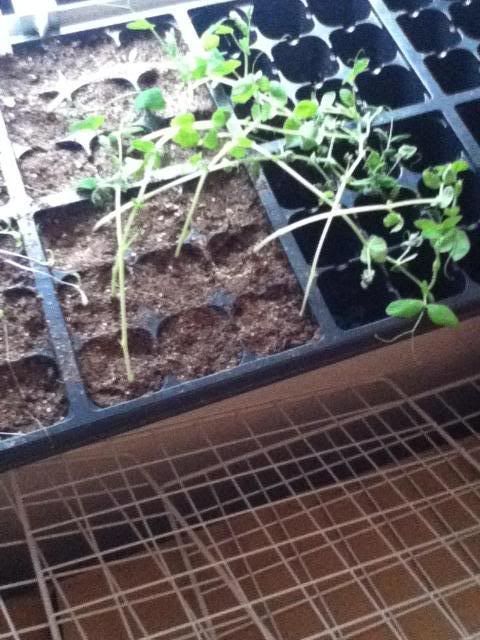 Although the MG training session suggested not moving plants outside until May, I am finding that some plants are in desperate need of being staked. I haven't figured out a good way to get them climbing that can be continued when the seedlings are transplanted outside. My pea plants were doubled over in their plastic cells and the cucumber sprouts in both soil blocks and plastic cells are beginning to droop right as they sprout their first true leaves.
 While I'm risking death, if I don't plant them now, all the pea and cucumber seedlings are guaranteed to die. I wonder how people are able to keep such plants indoors for 6-8 weeks. I suspect my kitchen, even with grow lights, just isn't bright enough.
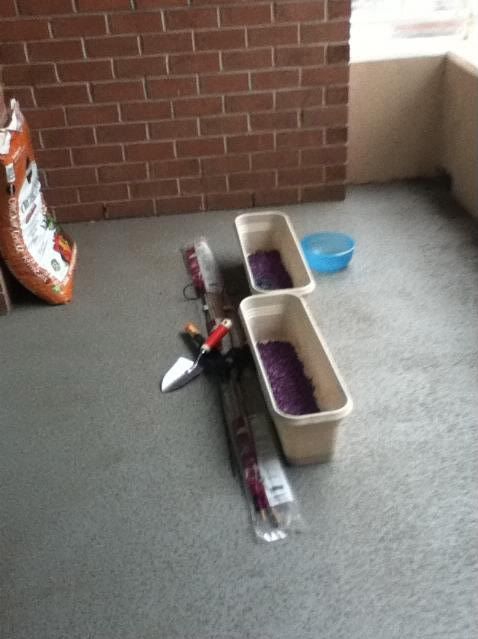 I brought my goodies from my trip to Home Depot to the balcony and surveyed the results. I have everything I need for now, at least to get some planting started.
I used some left over gravel to line the bottom of the planters and started shoveling the Miracle Grow container soil. Having worked briefly with this soil, I would not recommend it. It has too many sticks, rocks and other tidbits. I understand I bought "organic" potting soil, but organic sticks don't help little vegetable plants grow.
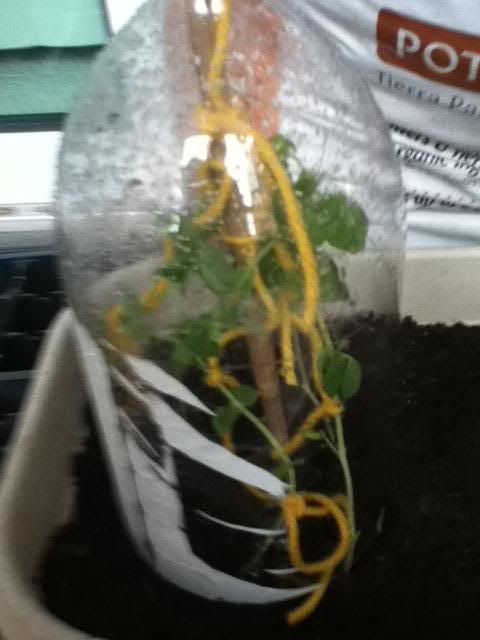 I popped the pea plants out of their plastic cells and arranged 5 of them in a circle around a standing bamboo stake. I patted the soil down around them and then went back inside. Who needs $4 garden ties when you have neon yellow yarn left over from a failed crochet project? I tied a knot around the plant stem and a knot around the bamboo stake. I then dropped a soda bottle cloch down the stake and around the pea plants.
Mental Note: Scissors and box cutters are not sharp enough to cut through even thin bamboo.
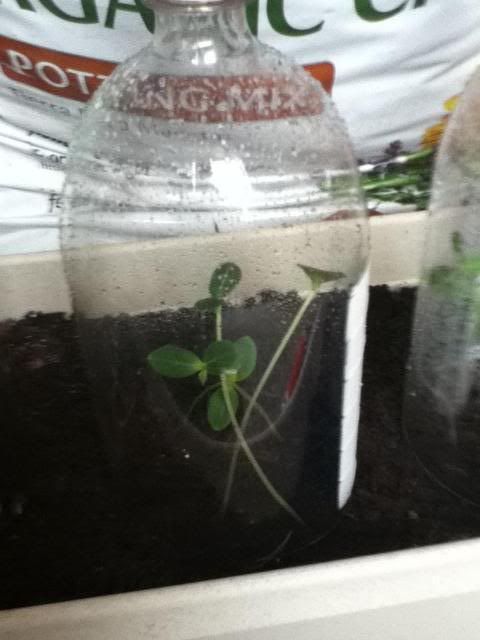
I then took the four best looking cucumber plants that had been growing in the soil blocks. 1 plant had failed to sprout and 1 had already fallen over. I dropped the plants into the dirt and covered with the second soda bottle. The third seedling group was from the plastic cell grown cucumbers. 1 plant snapped when I tried to get it out of the plastic cell. I was left with 5 good plants, 4 of which I planted and covered. I need to plant 3 more pea plants, but I ran out of soda bottles. With the weather being rather dismal and gray (in the 50's and cloudy all weekend), placing them outside with no cover is too risky.
Then again, Monday is supposed to hit 86 degrees. And I thought New England had wacky weather patterns!
Soil Blocks vs Plastic Cells
Seedlings:
1. Plastic cell plants sprouted first in all cases, with the head start being anywhere between 2-5 days. Slow sprouting plants had a larger difference and the time to sprout was more noticeable.
2. Soil blocked plants are less likely to be knocked down by watering and seem to generally stand on their own better. It's also easier to give them extra room if they get leggy.
3. Soil blocked plants require ALOT more water than plastic cell seedlings. I can't tell if it's my apartment or the blocks, but having so many sides exposed to air dries out the blocks much faster than cells. I've found myself watering daily.
Planting:
4. Planting soil blocked seedlings is a snap: dig hole, drop in the block, cover. Removing plastic cell seedlings can be risky: I lost one pea and one cucumber plant today.
Subscribe to:
Comments (Atom)